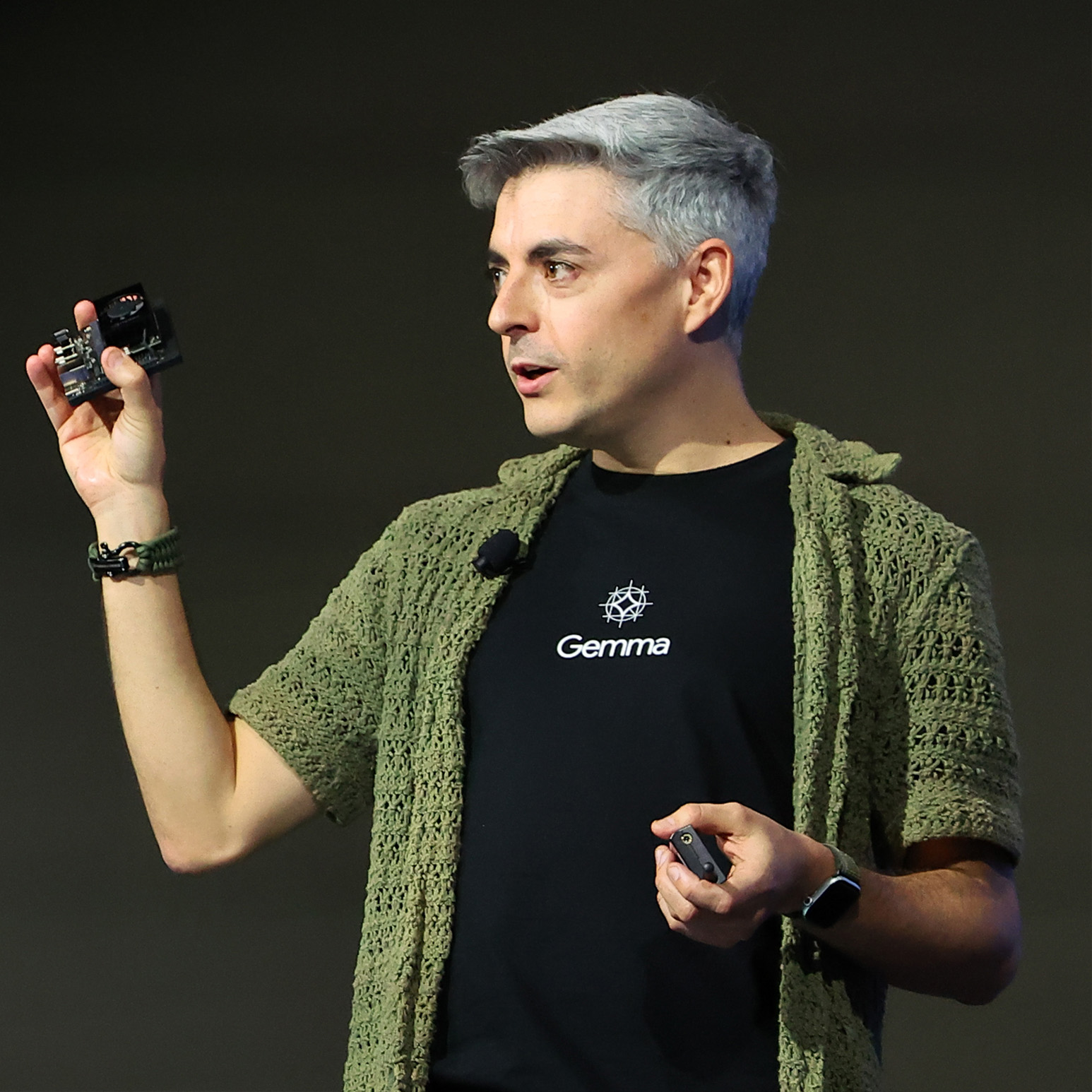
Bio
Tokens from my real brain:
I'm curious by nature and love to inspire others, that's why I bring papers from research to demos in no time. I am a mix between applied research and community building. Before NVIDIA I was at IBM Research on Quantum computing, where the project I made for the hackathon for fun, ended in a patent and with me working in that amazing lab in forests of Yorktown, New York.
Later, some people at OpenAI published GPT-2 as a repo, and I built a website around it during the first days, so people can ask questions, making a kind of "ChatGPT" before ChatGPT (I think it was the first GPT online worldwide!), I bought a NVIDIA Jetson NX, put it inside, and this indirectly brought me to work at NVIDIA!
So this is still my motto, play with things on the research phase, and make something!
And this is exactly what I do now at NVIDIA, playing with research (GR00T, Cosmos, Newton, Mujoco Warp, Isaac Teleop, etc.) [Will add all the keywords at the end], and creating demos around use cases that can inspire communities of developers, researchers, partners or enterprises.
I was also active in the academic area, as professor and leading the Technology Lab of IE Business School (ranked #1 in the world by the Financial Times during most of my time there), I built the WOWroom, an immersive demo space that positioned the business school worldwide (this project won the Reimagine Education Award by Wharton in 2018). I teach several clases in international MBAs, and IE also gave me its Teacher Excellence Award in 2017 and 2018.
Earlier, I co-authored the MalariaSpot paper in JMIR, where we used crowdsourcing to count malaria parasites in real medical images with results comparable to expert microscopists. It currently has 118 citations in OpenAlex.
This mix of research, teaching, community and demos is basically who I am. Give me a paper, a new model or a strange piece of hardware and I will probably try to turn it into something people can see, touch and learn from.
Recent Work 2026
Demos I built end to end for NVIDIA events in 2026. The recurring theme: how much AI you can fit on a single machine, and the engineering to keep it alive on a show floor.
- Physical AI, live in Japan. A Unitree G1 humanoid walking through a simulated smart factory and a Franka arm stacking cubes, physics fully on GPU with NVIDIA Newton, responding to commands in English, Spanish and Japanese. I built it end to end and handed it over to the NVIDIA team in Japan, where it runs today.
- Teleoperating robots in VR. For the GR00T N1.7 + LeRobot launch with Hugging Face, I drove the SO-101 robot arm inside Isaac Lab from a Quest 3 headset, and fixed the streaming stack along the way with two upstream contributions to Isaac Teleop (Seeed article ↗).
- Two humanoid robots, one Jetson. NemoCast: a live AI news show hosted by two UBTECH Alpha Mini robots at Computex 2026, with Gemma 4, Kokoro TTS and live English to Mandarin translation running locally on a single 8 GB Jetson Orin Nano Super.
- Watching a world model think. Interactive NVIDIA Cosmos demos on 8x H100s: real footage next to generated video on a slider, and a live viewer that shows every denoising step while the model generates.
- Text to video on a desktop box. A complete AI video pipeline (LTX-2.3, 22B parameters) built for GTC Taipei, running entirely on one DGX Spark: type a prompt, get a finished clip.
Current Role & Focus
- Physical AI demos. Humanoids and robot arms simulated with Newton and Isaac Sim/Lab, wired to natural language control. I run them live at NVIDIA events worldwide.
- Robot learning. GR00T foundation models and LeRobot SO-100/101 arms. I collect demonstrations by teleoperating in VR (Quest 3 over CloudXR), then fine-tune policies and measure if they actually improved.
- Generative AI on the edge. The latest open models (Qwen, Gemma, Llama, multimodal VLMs) running on Jetson Orin and Thor, where every megabyte of memory counts.
- Demos that survive the show floor. Automatic failover, watchdogs, rehearsal modes, and a post-mortem after every demo day.
- Hands-on content. Workshops and labs that developers and partners can reproduce on their own hardware. My rule: if you can't get the demo running in under 15 minutes, it's not finished.
- Community. I work with developer communities, students, researchers, and enterprise partners around the world.
Speaking & Global Engagement
My format is the live demo: real hardware, running in front of the audience. Some of the stages:
- Google Tokyo & Paris. The international debut of Gemma 2 in Tokyo (2024) and the Gemma 3 launch in Paris (2025), with demos running live on Jetson.
- Computex & GTC. Physical AI at the NVIDIA booths in Taipei: humanoid robots hosting a live news show from a single Jetson, and a GPU-simulated factory you command by voice. In 2026 I also gave my own session at GTC Taipei: "How to Run Open Models and Agentic AI Efficiently at the Edge" (replay ↗).
- Universities. Talks and labs for students and researchers getting started in AI and robotics.
- Industry events. Technical workshops and hands-on labs for developers and enterprise partners.
- Developer communities. Meetups and open source around robotics and generative AI on Jetson.
- TEDx & MIT Enterprise Forum. AI explained to general audiences with demos instead of slides.
Technical Expertise
• Newton & MuJoCo GPU physics
• GR00T (VLA foundation models)
• LeRobot SO-100/101 arms
• XR teleoperation (CloudXR, Quest 3)
• Qwen, Gemma, Llama families
• NVIDIA Cosmos world models
• Speech pipelines (ASR + TTS)
• Local inference: vLLM, llama.cpp
• DGX Spark (GB10)
• RTX workstations
• Edge computing devices
• Developer advocacy
• Educational content
• International speaking